According to the National Association of Colleges and Employers (NACE), “Career readiness is a foundation from which to demonstrate requisite core competencies that broadly prepare the college educated for success in the workplace and lifelong career management.”
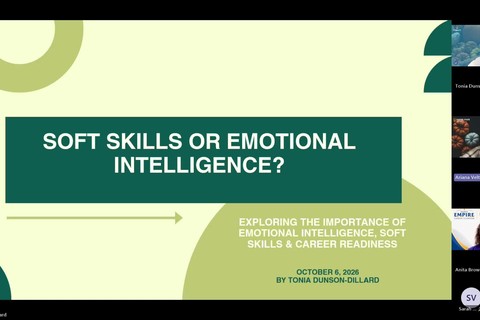
This presentation explores the importance of soft skills, commonly referred to as emotional intelligence, in today’s workplace. We will review key concepts of emotional intelligence, including Daniel Goleman’s Emotional Intelligence Model, and examine research …
By Anita DeCianni-Brown, '12 & '15
Anita DeCianni-Brown, '12 & '15Director, Career & Experiential Learning Services
College and career paths rarely follow a straight line. Students may face changing goals, unexpected challenges, new opportunities, and uncertainty about what comes next. This interactive presentation will explore …
By Anita DeCianni-Brown, '12 & '15
Anita DeCianni-Brown, '12 & '15Director, Career & Experiential Learning Services
You have more career-ready skills than you may realize. In this interactive session, discover how to identify and articulate the skills you’ve developed through work, …
By Anita DeCianni-Brown, '12 & '15
Anita DeCianni-Brown, '12 & '15Director, Career & Experiential Learning Services
Explore occupations by career categories and pathways and use real time labor market data to power your decision making.
Find career data by selecting keywordsKeyword Search
or, by filtering for industry and occupationIndustry Search
First, choose an industry of interest, then filter for occupation. (If you'd like to see data for a specific location only, filter by state.)
Type in a keyword to select a relevant occupation. (If you'd like to see data for a specific location only, filter by state.)
01
Occupation Description
02
Employment Trends
03
Top Employers
04
Education Levels
05
Annual Earnings
06
Technical Skills
07
Core Competencies
08
Job Titles
Occupation Description
Employment Trends
The number of jobs in the career for the past two years, the current year, and projections for the next 10 years. Job counts include both employed and self-employed persons, and do not distinguish between full- and part-time jobs. Sources include Emsi industry data, staffing patterns, and OES data.
Top Employers
These companies are currently hiring for .
Education Levels
The educational attainment percentage breakdown for a career (e.g. the percentage of people in the career who hold Bachelor’s Degrees vs. Associate Degrees). Educational attainment levels are provided by O*NET.
Annual Earnings
Earnings figures are based on OES data from the BLS and include base rate, cost of living allowances, guaranteed pay, hazardous-duty pay, incentive pay (including commissions and bonuses), on-call pay, and tips.
Technical Skills
A list of hard skills associated with a given career ordered by the number of unique job postings which ask for those skills.
Core Competencies
The skills for the career. The "importance" is how relevant the ability is to the occupation: scale of 1-5. The "level" is the proficiency required by the occupation: scale of 0-100. Results are sorted by importance first, then level.
Job Titles
A list of job titles for all unique postings in a given career, sorted by frequency.